
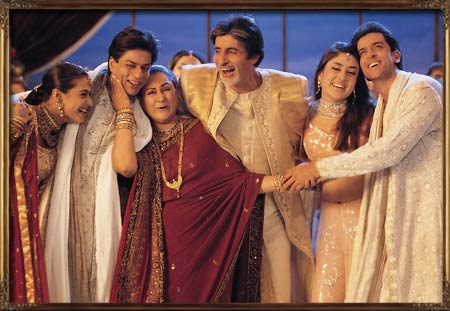
“Kabhi Khushi Kabhie Gham” is the title of a major Bollywood film, meaning “Sometimes happy, sometimes sad” and has about three instances of marriage in it. As per usual with Hindi films. Even though the plot has no parallels with my life, the title does, in all of its broken English glory.
It was August, and my aunt was in full swing of preparing her daughters ‘Asian’ wedding ceremony. It was just an excuse for her to sing, invite all of her friends, and show off, that yes, my son might be gay, and my daughter might have married a gorah (white boy), but we got him in a shalwaar kameez and her in a wedding lengha. (Not actually them.)
It wasn’t quite as extravagant as the pictures make out, I am just filling your head with dazzling lies.
A week before the function, my mum, sister and I all went to see my aunt, where my cousin and her husband were having a fashion show. It was completely against their will, they hate dressing up in traditional clothing, but they knew that the ‘Asian’ part of their wedding was all for my cousin’s mum.
This got everyone excited and thinking about what to wear. My sister had already bought an elegant sari and I felt left out. This calls for a trip to Southall. I whispered to mum, “What shall I wear?!” And she mentioned some clothes that I already own. Girl’s clothes. “I’m not wearing girl’s shalwaar kameez,” I established, and she ushered me into the kitchen where we could have a private word. My heart sunk, as I realised this is going to be the same as every other Asian wedding she’s requested I attend, and we’re going to have the same dispute about clothes. My mum sees my rejection of girl’s shalwaar kameez as a rejection of Asian culture – I don’t want to wear that because I don’t want to be recognised as Asian. She couldn’t deal with me wearing anything else, and well, you just don’t wear anything else at Asian weddings. The little boys wear jeans, the little girls wear dresses, and that’s about as far as fashion strays from the traditional garments. Well, the men do have more freedom, they can wear suits, shirts and ties. Which would work perfectly for me. But that would never happen in my mum’s eyes. She doesn’t see my rejection of girl’s shalwaar kameez for what it really is – I don’t want to wear that because I don’t want to be recognised as a girl.
After the ‘white’ wedding in July, I actually thought my mum had understood that this is how I present myself now. It just fitted so well, and felt so right. It seemed like it felt right for her too. Parents always surprise you, don’t they? She surprised me once again, as our conversation started in the kitchen with, “You know you don’t have to come to the wedding.”
My eyes stung with hurt. An emotional blow straight to my stomach. I waited, for an apology, for clarity, a sense of reality. Nothing. After all these years of her begging me to come to any wedding, for anyone, she’s finally given me the choice of whether I want to attend the one wedding for the one person I actually care about. Thank you, mum.
I choked out, “Wh-what? I want to come! I just want to know what to wear.”
“We have some outfits at home-”
“I’m not wearing girl’s clothes; I’m wearing boy’s clothes. Can’t I just wear a plain shalwaar kameez, or a shirt like I wore to their English wedding?”
“There are going to be Pakistani people, family visiting, you know Uncle is coming from Pakistan. They won’t understand, and they’ll keep asking questions.”
“Let them ask questions, I don’t care, it’s got nothing to do with me, I don’t know them.”
“It’s not nice, they’ll look and ask. Dad isn’t coming. He wanted you to stay at home with him. And if you and dad both don’t turn up, it’ll look like you’re both doing something together, and couldn’t attend the wedding.” My dad isn’t attending the wedding for family related political reasons. That, and he wasn’t actually invited.
I tried to swallow down a lump in my throat, trying to hold myself together. I calmly replied, “Okay, fine,” and sat out in the garden by myself. I could hear everyone chatting away, about which outfit they preferred, discussing the programme for the day. I’m not a part of it anymore. And that’s because of one person, my own mother. She had no idea what she has done. She has no idea what that meant to me, at the ‘white’ wedding. It was such a small thing, but it meant the world. It came to me; it was a small thing, and that’s all it was. She complied with the least confrontational option for her and didn’t even think of me. She will never know that for that day, I felt accepted as family, accepted as a son. She’ll never know because she’s going to always be thinking of herself.
I left by myself, driving straight back to mine, thank goodness. I couldn’t get out of there sooner. I hadn’t felt that unwanted in a long time. Especially by my own mother. My emotions escalated, with every fake smile and “Yes, I’ll see you on the weekend. Yeah, I can’t wait for her big day either. See you soon.” It was a dark drive home.
The (second) big day approached, and I was meant to be driving down for the weekend. My sister and my dad were both asking when I’ll be home. I didn’t know what to say. I felt so torn, so ripped up inside. I wasn’t just letting down my cousin, I was letting down my sister, who has always been forced to go to functions by herself. I discussed it with a few friends, and had a few options. There was no way I was going to go dressed in girl’s shalwaar kameez. That was off the table. But what could she do if I wore boy’s shalwaar kameez? Well she couldn’t do much because I don’t have any. I have one but it’s too boring, not party-wear. I couldn’t borrow my dad’s – too short – or my stepdad’s – too tall. I could just wear what I wore to the ‘white’ wedding, a smart but casual shirt and tie outfit. Put my foot down, show everyone that I’m here for one person, wearing what I want – they don’t care and neither should you. Hooray!
Except that, well, I’m just not that strong. The discomfort would be excruciating. I know that look in people’s eyes, when they’re scanning you up and down, wondering who you are and what has made you look like that. And I know Pakistanis, I know what my relatives are like, and right now, it just doesn’t seem worth the hassle. It would be such a blow, that I don’t think I could recover for a long time. If I was in a different, brighter place, I would’ve been able to put my foot down, and I wish I could have done. But there was too much pain from what had already happened, I couldn’t have dealt with any more.
My mum called me the day before, to discuss travel arrangements I imagined. But it was just a chit-chat. I couldn’t give a fuck about anything she spoke about – her job, her husband, her day so far. The wedding was all I could think about, and she hadn’t even brought it up! I interrupted her, unable to take it anymore, “I’m not coming this weekend.” She barely acknowledged it. And then carried on talking about when she’s off from work. She didn’t care. She didn’t even care. She knew I wasn’t going to come, and she didn’t want me to. Otherwise she would have asked me, or even would have fought when I said I won’t be there at all that weekend. My vision blurred with tears that wouldn’t release themselves. The lump in my throat wouldn’t go down, and I left the conversation.
I knew from then on, I didn’t want to ever make the effort with my mum again. She doesn’t deserve anything from me. Until she acknowledges my feelings and decides to put them first for once. I told my dad that I wouldn’t be coming because mum made me feel uncomfortable. He was understanding because considering she’s his ex-wife, he knows what a selfish person she can be. I told my sister a little more detail but couldn’t bring myself to explain how it made me feel inside, how it shook my sense of self, and my self-worth. I’m still trying to explain it to myself and come back from that. Every time I hear from my mum, I feel the same feelings of rejection, and the same feelings of wanting to push her away. I don’t know when they’ll fade but if I were her, I wouldn’t have much hope.
What does any of this have to do with a Bollywood film that you probably can’t even pronounce? I felt like it related to the theme of Asian weddings. (It barely does, I know, I was just feeling pretty desi today. And well, ‘sometimes happy’ might have just been a one time, but I was still happy. ‘Sometimes sad’ is what just happened to follow and stay.
And like all great Bollywood films, I shall end this story with a song.



“It came to me; it was a small thing, and that’s all it was. She complied with the least confrontational option for her and didn’t even think of me. She will never know that for that day, I felt accepted as family, accepted as a son.”
Oh, Smash, that must have stung in a way I can scarcely believe. Though my ex divorced me over my transition, it was because she accepted me as a woman and was no longer the man she’d married. To know that you had received “acceptance” because it was the path of least resistance must have been truly damaging.
I’m so sorry you had to endure that.
-Connie
I’m sorry you had to go through that with your ex, that’s so sad.
Thank you so much for understanding Connie.